Capability
Automated Privilege Classification
Privilege review is where inadvertent waiver risk is highest. Discovarc identifies privilege indicators across the document population and generates the structured log that production requires.
What Automated Privilege Detection Covers
High-volume privilege review carries two distinct risks: inadvertent disclosure of actually-privileged documents, and over-designation that burdens opposing counsel and invites motion practice. Discovarc addresses both by providing a systematic privilege scan rather than relying on each reviewer to independently identify privilege signals.
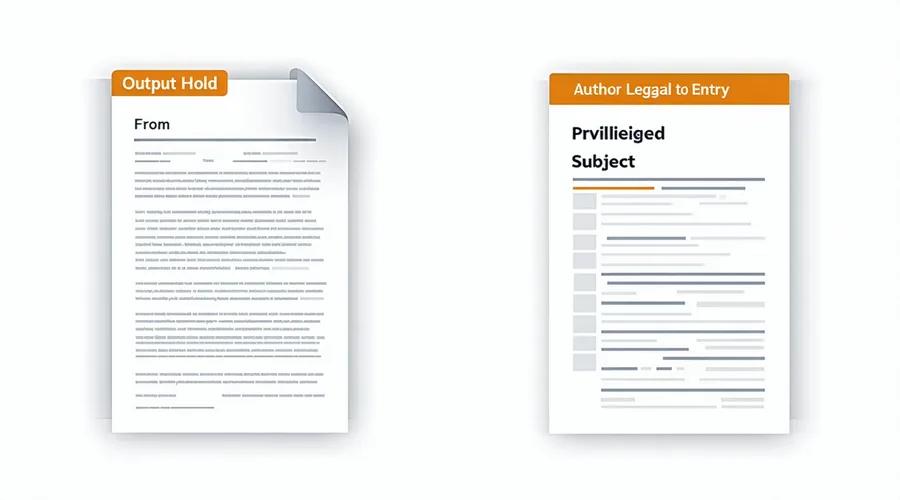
Attorney-client privilege indicators
- Attorney names in From/To/CC fields matched against the matter's attorney roster
- Legal hold language, outside counsel engagement terms, and litigation context phrases
- Subject lines indicating legal advice request or counsel feedback
- Distribution patterns suggesting confidential attorney-client channel
Work product doctrine indicators
- Documents created after litigation was reasonably anticipated
- Internal legal team analysis, strategy memos, draft pleadings
- Interviews and investigation notes with legal counsel involvement
How Privilege Signals Are Identified
Named-entity recognition on attorney rosters
Counsel provides a list of attorneys on the matter — outside counsel, in-house counsel, privilege holders. Discovarc scans email metadata fields for names matching the roster. This is more reliable than keyword search because it accounts for name variations (initials, partial names, common misspellings) and handles distribution list resolution.
Phrase detection for privileged context
Certain phrase patterns are reliably associated with privileged communications: requests for legal advice, statements made in confidence to counsel, attorney strategy discussions. Discovarc maintains a configurable phrase library for each matter type — litigation privilege language differs from regulatory investigation language.
Custodian-role mapping
Documents from certain custodians carry higher privilege probability regardless of content — a general counsel's email requires different treatment from a plant manager's. Custodian role metadata is factored into the privilege scoring alongside document-level signals.
Privilege Log Generation
Privilege log production is a known labor bottleneck in discovery. Each document withheld on privilege grounds requires a log entry with sufficient specificity to allow opposing counsel to assess the claim. Courts have found inadequate privilege logs to be grounds for compelling production.
Log fields populated automatically
| Field | Source | Example |
|---|---|---|
| Date | Document metadata | 2024-03-15 |
| Author | From field / creator metadata | J. Martinez (GC) |
| Recipients | To/CC fields | Outside Counsel (privileged) |
| Subject/Description | Subject line (redacted if needed) | RE: Legal Hold — Matter 2024-07 |
| Privilege Basis | Detected privilege type | Attorney-Client Privilege |
| Document Type | File format and threading | Email (chain) |
| Bates Range | Production Bates number | PRIV000047–000049 |
Clawback risk reduction
Inadvertent production of privileged documents creates clawback burden under FRE 502. Discovarc's pre-production privilege scan is designed to surface privilege indicators before the production set is finalized — reducing the probability that a document missed in first-pass review reaches the opposing party. Attorney review of flagged documents is required before any document is removed from the production set.
Technology Tool — Not Legal Advice
Discovarc identifies privilege indicators to assist attorney review. Final privilege determinations require attorney judgment. Discovarc is a technology tool and does not constitute legal advice. No attorney-client relationship is created through use of Discovarc. The privilege log fields populated by Discovarc should be reviewed and validated by supervising counsel before disclosure to any third party.
Work product doctrine protection and attorney-client privilege are legal determinations governed by applicable jurisdiction law and the specific facts of each matter. The presence of privilege indicators does not establish that privilege attaches, and the absence of detected indicators does not establish that privilege is waived.
Bring your matter type — Request a Walkthrough.
We'll walk through how privilege detection maps to your custodian profile and matter type.
Request a Walkthrough